"The people will not revolt. They will not look up from their screens long enough to know what is happening." (O'Brien during the production of 1984 film) In my opinion technology thus far has been both a blessing and a curse for humanity, particularly in regards to neuroscience and cognitive functions. The brain itself is a beautiful work of art, chemistry, and electricity. It is a resilient yet fragile creation that sets humanity apart from the other creatures of Earth. During the lectures this week I found one statement very interesting. Vesna stated that most scientists have an interest in art. This is an incredibly true statement particularly in the field of neuroscience due to the amount of creativity necessary in order to analyze the brain in living patients. Once we acquired the ability to see the synaptic systems of organisms through microscopy it revealed just how beautiful the brain and its neurons can be.
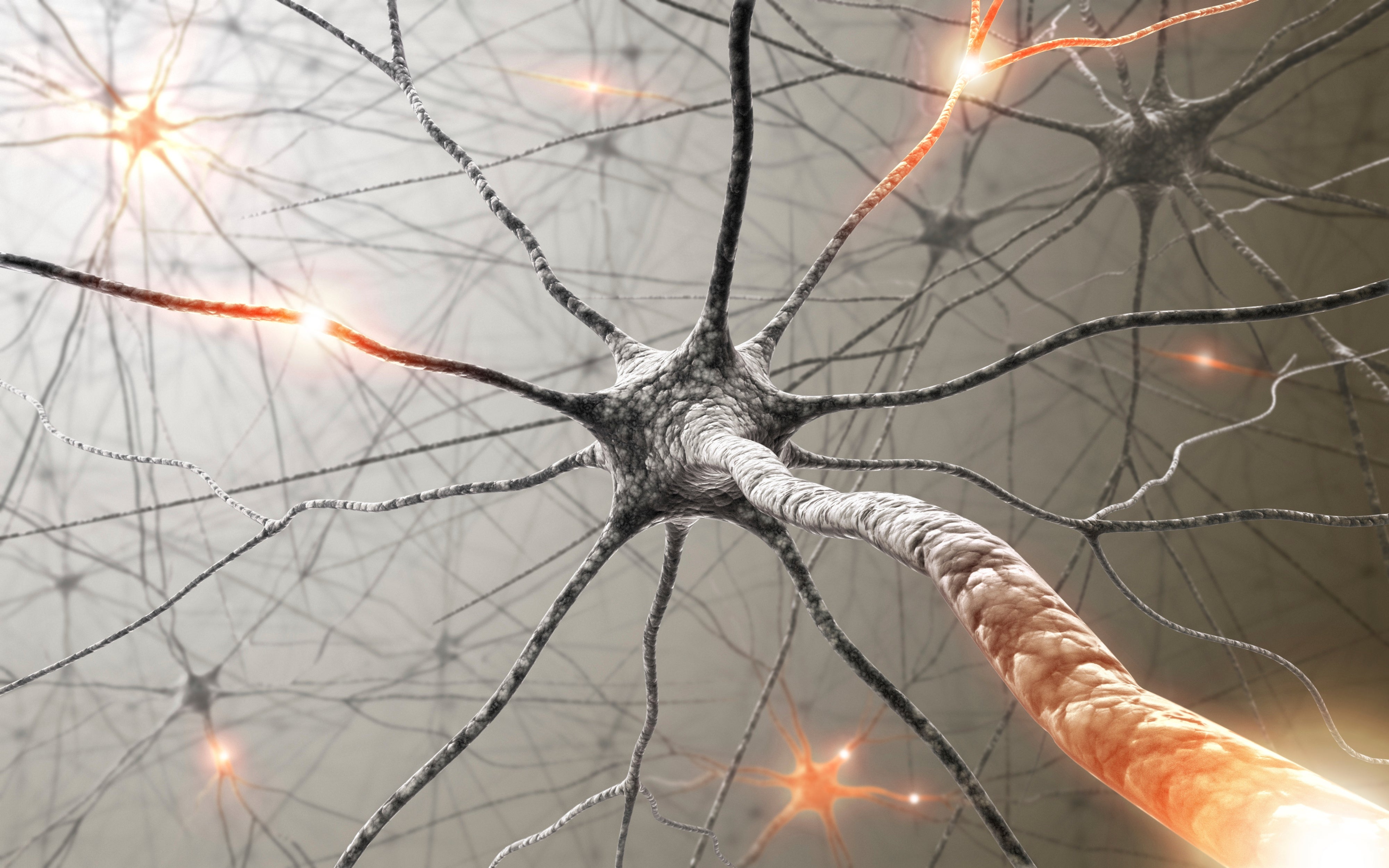
Neuroscience is a field that is relatively new and constantly evolving at an extremely rapid rate. The artistic element is extremely important in this regard to allow for imaging and visuals of microscopic and chemical interactions that are constantly occurring in the brain. These visuals can be incredibly helpful to researchers and scientists by enabling them to imagine the structure and functions of various elements that they would otherwise be unable to truly visualize. Actual images of the synaptic processes within the body are not quite as helpful yet as those created by artists due to the limitations of physical imaging technology at detecting electrical currents.
https://youtu.be/GIGqp6_PG6k
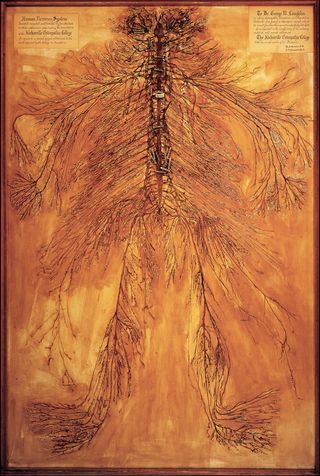
The nervous system itself is a beautiful creation of nature. The fact that our bodies have the ability to transmit electrical signals throughout the entire structure is absolutely amazing. The fact that humanity didn't develop the ability to do this until the 19th century is just another example of nature one upping humanity yet again.
Bosgraaf, Leonard, director. Firing Neurons | Cell Dance 2010, Public Outreach Video Winner, 2010, https://www.youtube.com/watch?v=GIGqp6_PG6k. Accessed 13 May 2022.
Choi, Charles. “Artificial Synapses’ Could Let Supercomputers Mimic the Human Brain.” Scientific American, 20 June 2016, https://www.scientificamerican.com/article/artificial-synapses-could-let-supercomputers-mimic-the-human-brain/. Accessed 13 May 2022.
Specktor, Brandon. “Here's What You'd Look Like as Just a Nervous System.” LiveScience, 1 Feb. 2018, https://www.livescience.com/61599-dissected-nervous-system-photo.html. Accessed 13 May 2022.
References:
Allen, Micah, and Karl J Friston. “From Cognitivism to Autopoiesis: Towards a Computational Framework for the Embodied Mind.” Synthese 195.6 (2018): 2459–2482. Web.
Bucklow, Christopher et al. Bacon and the Mind : Art, Neuroscience and Psychology / Christopher Bucklow, Steven Jaron, Darian Leader, John Onians, Semir Zeki and Tomohiro Ishizu. London: The Estate of Francis Bacon Publishing, 2019. Print.
Oliveira, Clara Costa. “What Bateson Had in Mind About ‘Mind’?” Biosemiotics 6.3 (2013): 515–536. Web.
Gardner, H. Art, Mind and Brain: a Cognitive Approach to Creativity. New York: Basic Bks, 1982. Print.
Nowakowski, Przemysław R. “Commentary: The Embodied Brain: Towards a Radical Embodied Cognitive Neuroscience.” Frontiers in Human Neuroscience 9 (2015): 623–623. Web.
Art and Robotics In my mind robotics has always seemed to be a work of art in itself. There is beauty and passion involved in the creation of a robotic or engineering work that certainly evokes an emotional response. I believe that as robotics become more advanced this artistic aspect of the field will only continue to be more important. This seems particularly apparent in the creation of sentient machines and those meant to imitate human beings. Yet robotics can also be incredibly beautiful and moving when utilized to portray an important message. Can't Help Myself By far one of the most interesting pieces of art involving robotics is the work of Chinese artists Sun Yuan and Peng Yu. The robot that they built is constantly trying to contain its own hydraulic fluid as it gradually loses its ability to control the amount that is released. When it first began its mission it was successful in controlling the leak, yet it was set up for failure and never actually had a cha...
My name is Ryan Morrissey and I am in my final quarter at UCLA. As a history major I have a unique perspective on the confluence and divide between the arts and sciences. It is necessary as a history major to have a general understanding of the influence of both fields in order to assess their impacts on the progress of humanity. I believe that the time with the most interaction between the fields was the Italian Renaissance. During this time there was no separation between scientists and artists, allowing for greater innovation and the analysis of scientific studies from an artistic perspective. Davinci embodied this confluence through his engineering projects and the study of the human body itself. https://leonardodavinci.stanford.edu/submissions/clabaugh/images/vm/leonardo.jpg Both Vesna and C.P. Snow discussed the origins of the divide between the fields of study and the overall negative impact this will have on academia and progress. Additionally ther...


Comments
Post a Comment